Entropia Museum is a community-driven archive preserving the history of Entropia Universe. If you would like to help support the hosting and development of the archive, you can contribute below.
Entropia Universe has evolved over decades, beginning as an experimental real-cash economy platform in the 1990s and expanding into a multi-planet virtual universe. This archive documents the major events and milestones that shaped its development.
This timeline documents important milestones in the history of Entropia Universe. The archive will continue to grow as more historical events and community contributions are added.
Development during this period focused on building the core technology behind a persistent online universe with a real cash economy. The system would later become the foundation for Entropia's unique financial model.
MindArk's development team began implementing systems for item ownership, player trading, and a currency exchange model tied directly to real-world value through the Project Entropia Dollar (PED).
Founded by Jan Welter-Lundberg, MindArk was established in Gothenburg, Sweden, with the ambitious goal of creating the world's first virtual universe featuring a stable Real Cash Economy (RCE). This year marked the transition from early conceptual designs into formal software engineering and architectural planning for the Project Entropia universe.
In late 2000, MindArk licensed the NetImmerse 4.0 engine from Numerical Design Limited (NDL). This engine provided the graphical framework for the early 2001 beta and the 2002 Commercial Open Trial. It is a common historical misconception that the game launched on "Gamebryo"; in reality, NetImmerse was only rebranded to Gamebryo in 2003, making NetImmerse the true "ancestor" engine of the Entropia Universe.
On May 14, 2001, MindArk officially transitioned Project Entropia into its first phase of external beta testing. This highly restricted period involved a small group of technical testers focused on validating the database stability of the Real Cash Economy. This era saw the birth of the 'Entropia Pioneers' community, who utilized independent forums to document the first-ever hunting statistics and maps of a world that was still closed to the general public.
On June 26, 2002, MindArk issued a landmark press release revealing that their Gothenburg headquarters had been raided by approximately 70 marshals. The raid was initiated by a complaint from the Business Software Alliance (BSA) and Microsoft regarding unlicensed software use. MindArk vehemently denied the charges, with CEO Jan Welter-Lundberg famously suggesting the move was a tactical attempt to disrupt the development of Project Entropia. The lawsuit was eventually dropped in March 2005 after MindArk successfully proved all software was legally procured.
Beta participants explored the early Calypso environment and helped test the foundational gameplay systems that would later define the Entropia Universe experience.
On January 30, 2003, MindArk released Version Update 4.2, commonly referred to as the "Gold" release. This milestone officially transitioned Project Entropia from a trial phase into a fully operational commercial service. It introduced refined economic systems, expanded the world map of Planet Calypso, and stabilized the withdrawal process, proving to the world that a virtual economy linked to real-world currency was a viable business model.
Released on November 23, 2004, VU 6.3 was a critical step in the "Treasure Island" saga, opening the island's buildings and areas for public viewing ahead of its legendary auction. The update also delivered significant quality-of-life improvements to the Auction House, including the "Last Calls" section, an increase in seller item limits from 5 to 15, and the categorization of minerals into specific headings. Additionally, this update introduced "Public Houses," allowing estate owners to open their properties to all participants.
The sale attracted international media attention and demonstrated the real-world economic value that could exist within virtual worlds.
The asteroid purchase by the avatar Jon NEVERDIE Jacobs became one of the most famous transactions in gaming history and further cemented Entropia Universe's reputation for high-value virtual assets.
The name change reflected MindArk's long-term vision of expanding the platform into a multi-planet universe rather than a single world.
The move to CryEngine promised dramatically improved graphics and modernized the visual experience of the entire universe.
The CryEngine upgrade transformed the visual presentation of the universe and required rebuilding large portions of the environment and game systems.
Developed by Neverdie Studios, Rocktropia introduced a music themed world inspired by rock culture and celebrity collaborations. It was one of the earliest examples of the Planet Partner Program in action.
In September 2010, First Planet Company (FPC)—the MindArk subsidiary then managing Calypso—signed a landmark agreement to acquire the massive player-run database of EntropiaForum.com. This acquisition transformed the independent site into the official "Planet Calypso Forum" (PCF) to centralize developer communication. However, the transition was complex: while FPC took the historical data to PCF, the original site owner, "711," relaunched EntropiaForum in November 2010 as a completely independent, multi-planet community platform with a fresh database. This event fundamentally split the community's archival history between the official developer channel and the independent player forums.
In November 2010, Jon NEVERDIE Jacobs sold his famous Asteroid Space Resort in a series of transactions totaling $635,000 USD. The largest single portion, which included eight biodomes and the main club facilities, was purchased by John Foma Kalun for $335,000. Following the sale, the iconic destination was renamed FOMA Fortuna. This event solidified Entropia Universe's place in the Guinness World Records and remains a cornerstone of virtual real estate history.
Next Island focused on exploration and mythology, including time travel mechanics allowing players to visit different historical eras within the planet.
Arkadia introduced a story-driven sci-fi setting and quickly became one of the most active planets in the Entropia Universe ecosystem.
Released on June 21, 2011, VU 12.0.0 introduced the vast 3D Space environment, connecting the various planet partner worlds. This update added customizable spaceships, including the high-value Motherships and Privateers, and established the Space combat and hauling mechanics that defined interplanetary trade for over a decade.
Cyrene added extensive narrative content, new creatures, missions, and unique gameplay mechanics built around its military science-fiction setting.
Monria introduced horror themed environments inspired by the works of H.P. Lovecraft and expanded the universe with the first major player focused moon environment.
Toulan introduced environments inspired by Middle Eastern mythology and folklore, expanding the cultural diversity of planets within the Entropia Universe platform.
The Mayhem events introduced large-scale seasonal competitions that became a staple activity for high-level players.
Version Update 16.5.0 introduced the Codex system, a major overhaul of the mission and progression mechanics in Entropia Universe. The system replaced many older hunting missions such as the Iron Challenges with a unified Codex interface that tracks creature kills, rewards, and skill gains across multiple planets.
VirtualSense became the new operator of Planet Toulan, continuing development and support of the planet within Entropia Universe.
On February 21, 2024, MindArk released Version Update 18.0.0, which completely overhauled the player experience with a new Heads-Up Display (HUD) and unified UI windows. Key features included the introduction of UI Edit-Mode for movable elements, a new Action Bar system to replace the legacy dashboard, increased inventory grid sizes, and an updated login screen. This update was a major step in modernizing the game's functionality and visual performance.
Released in September 2025, this update introduced the planet-sized starting zone of Setesh , replacing the long-standing Thule tutorial area. Designed to modernize the new player experience (NPE) ahead of the Unreal Engine 5 transition, Setesh features a massive scale expansion with updated mission flows, teaching new colonists the core mechanics of the real-cash economy in a more immersive and high-fidelity environment.
Released on December 9, 2025, in Version Update 19.2.0, this update marked the initial rollout of a new Modern User Interface framework based on Chromium. It introduced resizable, sharper windows with GPU/CPU rendering options and covered initial interfaces like Voting and Immersive NPCs. This technical overhaul was a critical prerequisite for the game's migration to Unreal Engine 5.
Released on April 15, 2026, in Version Update 19.6.0, this update introduced the
long-awaited Fishing and Cooking professions to Entropia Universe. Players gained the
ability to fish across designated water bodies using rods, bait, and skill-based mechanics
tied to timing and location. Different fish species were introduced with varying rarity,
value, and usage.
Fishing established a new resource loop, allowing players to gather raw materials
which could then be processed through the newly added Cooking system. Cooking enabled
the creation of consumable items that provide temporary buffs, enhancing gameplay aspects
such as efficiency, regeneration, or performance in other professions.
The system introduced new skills, tools, and item categories, expanding both the economy
and player progression paths. It also encouraged exploration, as fishing locations and
optimal conditions varied across planets and environments. This update marked a significant
step toward deeper life-simulation mechanics within the Entropia Universe ecosystem.
Released during May 2026, this update introduced the first iteration of the Synths system,
an AI-driven feature designed to assist with economic activity and market circulation within
Entropia Universe. Synths were intended to help stabilize supply flow, improve resource
availability, and support long-term balancing efforts as the platform continued transitioning
toward Unreal Engine 5 systems and infrastructure.
Alongside the Synths implementation, MindArk released a new Shop Search feature that allows
players to search for specific items across participating player-owned shops. The system
greatly improved item discovery and reduced the time required to locate equipment, resources,
and consumables throughout the economy. This marked one of the largest quality-of-life
improvements for trading and commerce in recent years.
The update generated widespread discussion across the community. Supporters viewed the Shop
Search system as a major improvement for accessibility and economic transparency, while the
Synths system sparked debate regarding the long-term impact of AI-generated economic activity
on Entropia Universe's traditionally player-driven economy. The release represented a notable
shift in how automation and support systems may shape the future of the platform.
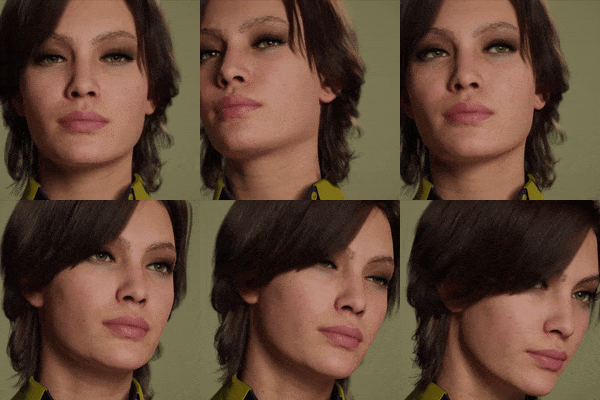
Released on September 8, 2026, Version Update 19.10 represented one of the most significant stages in Entropia Universe's transition toward Unreal Engine 5. The update introduced an entirely new generation of player avatars using higher-quality geometry, high-resolution textures, a new PBR skin shader, redesigned facial features, more than 20 new hairstyles, expanded colour customization, and a new facial animation system. All players received a one-time opportunity to recreate their avatar using the redesigned Character Creator, while NPCs were also migrated to the new character technology.
A large portion of the game's interface was rebuilt or modernized. Chat moved to a faster Chromium-based system, while the Message Center, Codex, advertisement screens, crosshairs, rifle scopes, and numerous other windows received major redesigns. The new interfaces were designed to reduce memory usage, improve responsiveness, and form part of the same technology base being prepared for the Unreal Engine 5 client.
The Auction received one of its largest overhauls to date. New features included Sell to Best Order, automatic pricing against the lowest comparable listing, integrated market information, percentage-based markup entry, batch selling through a new Sell Queue, additional safeguards against accidental underpricing, and the introduction of Quantum Set Capsules allowing complete equipment configurations to be packaged and sold as a single inspectable listing.
The planetary Map system was rebuilt with interactive 3D and 2D modes, allowing players to explore terrain, settlements, destinations, mission locations, events, and waypoints using more precise positioning technology. Chat and communication tools were also redesigned to handle long conversations more efficiently while adding improved navigation, appearance controls, shortcuts, and message filtering.
Major rendering optimizations were introduced alongside the interface changes. Static meshes and vegetation could now be rendered in instanced batches rather than individually, significantly reducing CPU workload in dense environments. MindArk reported test areas improving from approximately 30 FPS to more than 100 FPS under comparable conditions.
MindArk described Version Update 19.10 as a playable bridge between the existing Entropia Universe client and its Unreal Engine 5 successor. Many of the systems introduced in the update were developed for both clients and had already been tested inside Unreal Engine 5, making VU 19.10 one of the clearest signs yet that the long-running engine migration was approaching its final stages.
In August 2026, MindArk delivered one of the most important announcements in the history of Entropia Universe, confirming that development of the long-awaited Unreal Engine 5 client was almost complete and that the new client was scheduled for release before Christmas 2026.
The announcement marked the first firm release window for the Unreal Engine 5 migration after years of development, technical demonstrations, infrastructure work, interface modernization, asset conversion, and gradual deployment of systems designed to operate across both the existing and future clients.
MindArk described the engine migration as one of the most ambitious technological developments ever undertaken for Entropia Universe. The Unreal Engine 5 client is intended to provide the technical foundation for the next generation of the platform while preserving the persistent universe, economy, player assets, skills, estates, and history that the community has built over more than two decades.
The announcement was followed closely by Version Update 19.10, which introduced new avatars, character technology, interfaces, maps, communication systems, graphical improvements, and other components specifically designed as part of the dual-client transition. Together, these developments signalled that the migration had moved beyond distant prototypes and into the final preparation phase for the public Unreal Engine 5 release.
While no exact launch day was announced, the confirmation of a release before Christmas 2026 transformed the Unreal Engine 5 migration from a long-term development goal into a scheduled milestone for the future of Entropia Universe.